Pioneering the next generation of photonic technology — from silicon photonics integration to AI-driven optical network management.
Our research spans four core photonic disciplines, each driving measurable advances in optical networking performance.
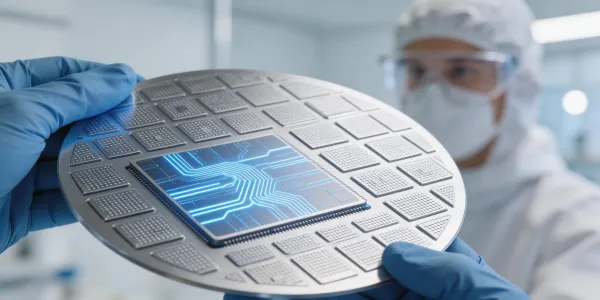
Monolithic integration of lasers, modulators, photodetectors, and multiplexers on CMOS-compatible silicon wafers. Our SiPho platform achieves 3 dB lower coupling loss than hybrid approaches while enabling volume manufacturing at semiconductor-scale economics. Current focus: co-packaged optics for switch ASICs delivering 51.2 Tbps aggregate bandwidth.
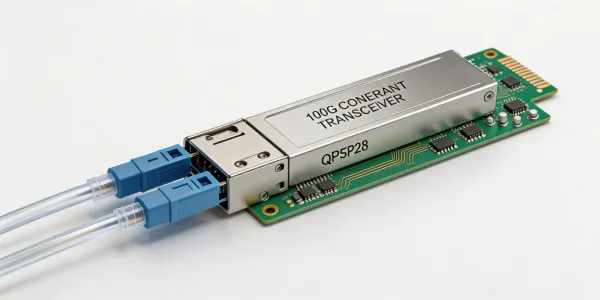
800G ZR+ and Open ZR+ pluggable transceivers with integrated DSP, achieving spectral efficiency above 6 bits/s/Hz. Our proprietary modulation algorithms extend reach by 25% compared to industry-standard implementations, enabling metro-to-long-haul convergence in a single pluggable form factor.
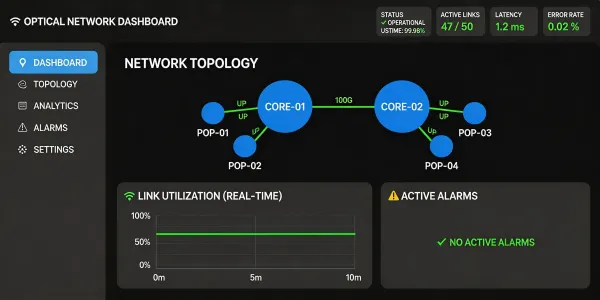
Machine learning models trained on petabytes of optical telemetry data. Our NeurOptic™ platform predicts fiber degradation 72 hours before impact, optimizes wavelength routing in real time, and reduces mean time to repair by 60%. Currently deployed across 12 carrier networks globally.
Research into quantum key distribution (QKD) components and entangled photon sources for next-generation secure communications. Our lab has demonstrated CV-QKD over 120 km of standard single-mode fiber, and we are actively contributing to ITU-T SG13 standardization efforts for quantum networking.

1.6T coherent pluggable transceiver prototype leveraging advanced 3nm DSP and 200 GBaud modulation.
Co-packaged optics integration with 51.2T switch ASICs — reducing datacenter power consumption by 40% at the optical layer.
Production-ready QKD modules for metropolitan quantum networks, compatible with existing DWDM infrastructure.
Photonic computing elements for AI inference acceleration — leveraging optical matrix multiplication for 10x energy efficiency gains over electronic alternatives.
Every photonic technology operates within defined constraints. Understanding these boundaries is essential for proper system design.
Our 800G coherent modules achieve maximum capacity at metro distances (under 120 km). Beyond 1,500 km, line rates typically step down to 400G or 600G depending on fiber type and span loss. Submarine-grade deployments at 400G require specific fiber profiles (G.654.E large effective area) and Raman amplification — standard G.652 fiber limits practical reach to approximately 2,500 km at 400G.
Co-packaged optics modules generate significant heat density. Current SiPho engines operate within a thermal envelope of 15-25W per module, requiring active cooling or advanced thermal interface materials when deployed in high-density switch linecard configurations. Ambient temperatures above 70°C can trigger automatic power derating, reducing effective throughput by up to 20%.
While our transceivers comply with MSA (Multi-Source Agreement) specifications, coherent 400G ZR/ZR+ modules may exhibit 1-2 dB performance variation when deployed in third-party line systems not optimized for our DSP implementation. We recommend pre-deployment interoperability testing and provide free sample modules for qualification in non-Lumentum chassis environments.